
THE EVOLVING CARCERAL LANDSCAPE IN AMERICA
APRIL 10-11, PRINCETON UNIVERSITY

The United States was founded as a police state, and has built up its prisons and policing systems over centuries in order to maintain state power and control. However, in recent years, we have seen a rapidly changing and growing carceral state take center stage in American life. From surges in immigration detention and policing by ICE, to the evolution of surveillance technology fueled by AI and social media, to the rollbacks of basic protections of the rule of law, the ground is shifting under us as we try to build a legal system that centers justice and dignity. Simultaneously, decades- and centuries-old injustices continue to fester, devastating the lives of people across the country.
This conference will gather students and scholars from Princeton and other institutions, activists and community organizers, local community members, and justice-impacted individuals to take stock of the current carceral landscape and the struggle to heal its wounds. What has changed in the 2020s, and how are those changes being lived within communities? What new threats to community safety must we combat, and what structural inequalities are yet to be dismantled? And how can we work together to imagine and build a system of genuine justice, on the shaky foundations of our current landscape?
Students for Prison Education, Abolition, and Reform (SPEAR) is thrilled to bring back our annual conference after seven years of hiatus. We hope that this weekend will be an opportunity for learning, reflection, community building, and calls to action, as we continue in our mission of educating, advocating, and agitating against the carceral state.
SPEAR is immensely grateful for the sponsorship and support of USG Projects Board, the Department of African American Studies, the Center for Transnational Policing, the Effron Center for the Study of America, and Princeton Progressives.
CONFERENCE SCHEDULE
FRIDAY, APRIL 10
-
KEYNOTE SPEAKER: Dr. Chelsea Moore, Co-Founder of Look2Justice & Smart Justice Policy Program Director @ ACLU WA
Chelsea Moore, PhD, is the Smart Justice Policy Program Director at the ACLU of Washington where she focuses on sentencing and conditions of confinement. She is also a lecturer in Law, Societies & Justice at the University of Washington. Dr. Moore is a co-founder of Look2Justice, a nonprofit she started with her husband, Christopher Blackwell, who is currently incarcerated at the Washington Corrections Center. Look2Justice is a nationally recognized organization led by currently incarcerated people that provides civic education to incarcerated people and their families in order to transform the criminal legal system. Dr. Moore holds a PhD in Political Science from the University of Washington. Her dissertation, “In Pursuit of the Pervert: Sexual Dangerousness and the Creep of the Carceral State,” examines the relationship between fears of sexual dangerousness and the expansion of mass incarceration. She sat on the Korematsu Race in Criminal Justice Task Force, the Board of Judicial Administration Alternatives to Incarceration Task Force, and is the co-chair of the Westcoast Poverty Center Roundtable on Criminal Justice. She is a published researcher, an award-winning instructor, a member of the Phi Beta Kappa honor society, and a former American Association of University Women Dissertation Fellow. Dr. Moore is a Henry M. Jackson Leadership Fellow and a Galaxy Leadership Fellow. In her free time, Chelsea belongs to an art collective dedicated to supporting women with incarcerated loved ones. Her work has been shown in galleries across Seattle.
Opening remarks by Ila Prabhuram ‘27, junior in the School of Public and International Affairs and co-president of SPEAR
-
Carceral technology is the latest violent apparatus to encroach on our lives. Companies like Palantir are making billions on selling their innovations to police and prisons, and the technologies and infrastructures that dictate our everyday life are built to capture and influence our every move. Professors and advocates will be gathering to discuss the entanglements between infrastructure, technology, and the carceral system, including what the rise of technologies like social media and AI means for those fighting against carceral violence.
SPEAKERS:
Basille Baudez is Associate Professor of Architectural History in the Department of Art and Archaeology at Princeton University. His latest single-authored book, Inessential Colors: Architecture on Paper in Early Modern Europe (Princeton University Press, 2021) was awarded the Alice Davis Hitchcock Medallion by the Society of Architectural Historians of Great Britain. He co-edited with Victoria Bergbauer of Carceral Architecture: From within and beyond the Prison Walls (Jovis, 2025), which offers readers an account of prison design and its effects by centering the voices of people impacted by the correctional system alongside those of activists, architects, designers, scholars, artists, and students. He regularly teaches community-engaged courses in partnership with New Jersey-based NGOs, such as the East Trenton Collaborative, the New Jersey Prison Justice Watch, and the Workwell Partnership.
Maya Dimant is a Lecturer in the Program in Law & Public Policy at the Princeton School of Public & International Affairs. Her work focuses on racial justice and deconstructing the modern carceral state, sitting at the intersection of experiential pedagogy, law, alternative dispute resolution, and reenvisioning justice systems. Maya is passionate about developing creative pedagogical models for students learning advocacy and extrajudicial strategies to become bold decarceration visionaries. She teaches experiential classes rooted in theory and policy where students learn and practice critical tools such as negotiation, mediation, restorative justice, oral and written advocacy, interviewing, and investigation through simulations, lived experience, and iterative feedback. She previously served as a Friedman Fellow/Co-director in the Prisoner and Reentry Clinic at George Washington University Law School, where she supervised students representing incarcerated people, and co-taught a seminar exploring how institutionalized white supremacy created the prison industrial complex. Prior to that, Maya was an Assistant Public Defender in Maryland, where she completed Gideon's Promise training and represented over 1,000 clients in misdemeanor and felony proceedings. Maya was also an Equal Justice Works Fellow at the James B. Moran Center for Youth Advocacy in Evanston, IL. A trained mediator and restorative justice circle keeper, her project focused on breaking the school to prison pipeline for students in low-income families by leveraging community-based criminal defense representation, suspension alternative skills-building workshops in schools, and local resources for collaborative reentry support. Maya holds a bachelor's degree in Sociology from Barnard College, as well as a J.D. and an LL.M in International Human Rights from Northwestern University.
Dillon Reisman (he/him) is a staff attorney at the ACLU of New Jersey. Dillon joined the ACLU-NJ in 2020, first serving as a legal intern, then as a Skadden Fellow. At the ACLU-NJ, Dillon conducts litigation and advocacy in criminal justice, immigrants’ rights, and democracy and liberty. Dillon is also responsible for spearheading ACLU-NJ's work at the intersection of civil rights and technology, tackling everything from unconstitutional government surveillance to harmful uses of artificial intelligence in public administration. Dillon’s work includes state and federal litigation, policy advocacy, and public education. Through it all, Dillon’s work shares a common theme of fighting against the harms brought onto individuals and communities by unjust systems of law and technology. Dillon’s work has brought him before multiple venues, including oral arguments in the New Jersey Supreme Court and Appellate Division. Dillon is a graduate of Princeton University, where he earned a bachelor’s degree in computer science with a certificate in technology & society, and of New York University School of Law. While in law school, Dillon participated in NYU’s racial justice clinic and technology law and policy clinic. He also completed internships for Chief Judge Colleen McMahon of the U.S. District Court for the Southern District of New York and the ACLU-NJ. Before becoming a lawyer, Dillon was a computer science researcher and software engineer specializing in data privacy and artificial intelligence.
Moderated by Ila Prabhuram ‘27, junior in the School of Public and International Affairs and co-president of SPEAR
-
The long-standing legacy of police violence was faced head on in the wake of George Floyd’s murder in 2020, with communities across the country demanding accountability and a radical approach to police reform and abolition. Nearly six years later, police violence continues to rage in communities across the country, and the shadow of the “War on Drugs” continues to motivate police presence and violence in vulnerable communities. This panel will hear from leaders in policy and advocacy on the current climate of police violence and drug enforcement, and look towards the struggle to keep communities truly safe and peaceful.
SPEAKERS:
Christopher Blackwell is the co-founder and Executive Director of Look2Justice, an organization that transforms the legal system by empowering impacted people through civic-education and narrative development. His writing has been featured in the New York Times, Washington Post, HuffPost, Mother Jones, and many more. He was awarded Narratively's prestigious 2023 Memoir Grand Prize, a Galaxy Fellowship in 2024, the 2024 Incarcerated Journalist of the Year by Prison Journalism Project, and was the first incarcerated person to present live with The Moth at their 2025 Community Showcase event in NYC. Follow his work on X: @chriswblackwell or on his website http://www.christopher-blackwell.com.
DaWuan Norwood (he/they) is policy counsel at the ACLU of New Jersey, where he focuses on issues related to racial and economic justice, free speech and protest rights, LGBTQ+ rights, and criminal legal policy. DaWuan joined the ACLU-NJ in 2024. While at the ACLU-NJ, DaWuan has led efforts to advance justice in housing including combatting the criminalization of homelessness and advocating for a statewide tenant right to counsel. He frequently engages in legislative advocacy, delivering testimony before the state legislature to protect and advance civil rights for New Jerseyans. Before joining the ACLU-NJ, DaWuan served on the power & democracy team at the Advancement Project. In this role, DaWuan participated in litigation of voting rights cases and worked with state-based partners to advance rights restoration efforts for individuals with prior felony convictions. DaWuan began their legal career as a fellow at Campaign Legal Center, specializing in voting rights and redistricting. Additionally, DaWuan is a commissioner on the Newark Civilian Complaint Review Board. He is a graduate of Howard University and Cardozo School of Law.
Udi Ofer is the John L. Weinberg/Goldman Sachs and Co. Visiting Professor and Lecturer of Public and International Affairs at Princeton University. He is the founding Director of the Policy Advocacy Clinic at Princeton University, a highly intensive year-long course that immerses students in the policy advocacy process with a focus on constitutional rights and human rights. His primary research areas include studying the problem of mass incarceration and devising bipartisan solutions to safely reduce incarceration rates while advancing equity, as well as studying effective human rights advocacy strategies. He teaches courses on civil rights, policing, criminal justice reform and policy advocacy, as well as a summer course for Princeton in Geneva, Switzerland on human rights advocacy. He is an elected member of the Council on Criminal Justice. He is also Chair of the International Advisory Council of the Association for Civil Rights in Israel and often lectures and writes about civil rights issues in Israel. Ofer has more than 20 years of experience as a civil rights lawyer working on issues related to criminal justice reform, national security, free speech and racial justice. For two decades, Ofer worked as an attorney at the American Civil Liberties Union (ACLU), where he helped to transform the organization, expanding its work into new issue areas and tactics. He was the founding director of the Justice Division of the ACLU and served as the Deputy National Political Director of the ACLU. Ofer's work has led to passage of hundreds of laws and policies across the nation to reform the criminal justice system. His work and research have been cited by the New Jersey Supreme Court and the United States Court of Appeals for the Fourth Circuit and Tenth Circuit.
Racquel Romans-Henry is the Director of Policy and Advocacy at Salvation and Social Justice (SandSJ), a non-partisan, Black faith-rooted public policy organization in Trenton, NJ. She works to elevate marginalized voices and ensure their lived experiences shape statewide policy. Her advocacy has driven major reforms, including cannabis tax reinvestment, police licensure, and the Seabrooks-Washington Community Led Crisis Response Act—establishing community-led crisis response teams for mental health and substance use emergencies. She leads statewide efforts to address racial disparities with a focus on, but not limited to, drug policy and sentencing reform, Black maternal health, and community-based violence interruption models. Known for her integrity, passion, and sharp policy insight, Racquel builds frameworks that empower communities and equip advocates to translate lived experience into lasting systems change. Drawing on more than 15 years of experience in federal government and two decades dedicated to movement building, Racquel excels at forging meaningful connections and helping others “speak truth to power.” She holds a Master’s degree in Public Policy and International Affairs from William Paterson University and is a proud wife and mother of two daughters. Recognized for her impact, Racquel’s contributions have been celebrated as a multi-time recipient of Insider NJ’S Powerful Women Recognition.
Moderated by Vinayak Menon ‘27, junior in the School of Public and International Affairs and president of Princeton Overdose Prevention (POP)
-
Students from Princeton and other universities are invited to an evening social to share how we are standing up against the carceral landscape on campuses across the country, and to build joyful community! Meet other cool students, enjoy pizza and cupcakes, and chat about everything from carceral justice to campus life!
Location: Campus Club 107 (5 Prospect Ave). Undergraduate and graduate students from all institutions welcome!
SATURDAY, APRIL 11
-
Immigration justice advocates have long recognized the deep and violent connections between the immigration system and the carceral system in the US, also called crimmigration. However, the second Trump administration has brought a frightening renewal of this system, exemplified by both the expansion of immigration detention and the incursion of ICE forces in Minneapolis, Los Angeles, Chicago, Charlotte, and beyond. How does the carceral system manifest at sites of immigration enforcement, from borders to asylum courtrooms to everyday communities? What carceral tactics have expanded in recent years, and how are these violent systems experienced by our local immigrant communities? This panel will have a specific focus on immigration detention and enforcement in New Jersey, and the struggle of local communities to protect immigrant lives in the face of increased attacks.
Breakfast will be provided beginning at 9:30 am.
Thomas Coulouras, Organizer, Comunidad en Retorno (bio forthcoming)
Asma Elhuni, Rapid Response Organizer, Resistencia en Acción NJ (bio forthcoming)
R. Delaney Rohan is a supervising attorney in the Immigration Law Unit of The Legal Aid Society, where he has worked as a detained removal defense attorney for over eight years. Based in Brooklyn, NY, he has represented New York residents detained in detention facilities, federal prisons, and county jails across the country, including in New York, New Jersey, Pennsylvania, Louisiana, Georgia, and Guantanamo Bay. He holds a JD from Brooklyn Law School, a MA from American University, and a BA from University of Florida.
Sarah Tosh is Assistant Professor in the Department of Sociology, Anthropology, and Criminal Justice at Rutgers University-Camden, and a critical researcher focused on the punitive intersections between drug, criminal justice, and immigration policy in the United States. Her book, The Immigration Law Death Penalty: Aggravated Felonies, Deportation, and Legal Resistance was published in 2023 by New York University Press.
Moderated by Kristin Nagy ‘27, junior in the Department of Anthropology and co-president of SPEAR
-
Under the New Jersey Constituion, only the Governor has the power to grant clemency, which includes pardons and commutations, to incarcerated individuals or those on parole. From June 2024 to January 2026, Governor Phil Murphy offered nearly 500 people pardons and commutations of sentences to incarcerated people in New Jersey. As a new governor takes office, how are the opportunities for individuals to be granted clemency changing? How do we offer a chance at freedom and dignity for justice-impacted individuals in our state? This panel, presented in collaboration with SPIA in NJ, will hear from those most directly involved in New Jersey’s clemency process and those advocating to expand the accessibility of early release opportunities.
Lunch will be provided directly after the panel.
SPEAKERS:
Natasha Camhi began her policy career at the Brennan Center for Justice, where she researched and analyzed federal criminal justice policy and helped direct the Justice Program’s communications, media, and operational strategy. After receiving her Master of Public Policy degree from the McCourt School of Public Policy at Georgetown University, she worked in the non-profit space providing technical assistance to many of the nation’s most progressive elected prosecutors, and advocating to improve healthcare and Medicaid access for the justice-involved population. Most recently, Ms. Camhi served as a Policy Advisor in the Office of Governor Phil Murphy, where she played a critical role in designing and leading the Governor’s landmark clemency initiative. While there, she also helped manage and shape statewide criminal justice policy, including reducing incarceration for technical parole violations, eliminating public defender fees, and restoring the right to serve on a jury to those with criminal records.
Antonne Henshaw is a Rutgers Camden School of Criminal Justice Graduate School Student, the CEO and Founder of the Transformative Justice Initiative, and the creator of “Meet Em at the Gate” and in partnership with “Meet Her at the Gate” with Severe Solutions LLC. He is a founding member of N.J.S.T.E.P., the New Jersey Scholarship and Transformative Education in Prisons Program, which began organizing in Trenton State Prison in 1992. Mr. Henshaw is a motivational public speaker, entrepreneur, NuEntry Opportunity Specialist for Camden County, and one of the lead credible messengers in New Jersey. Mr. Henshaw has dedicated himself to eradicating mass incarceration and transforming legislation to end the structural violence that threatens the public health of our communities. He is an outspoken advocate against police brutality in and outside of the carceral spaces of New Jersey. He is committed to educating the Community about the machinations of brutality that permeates the carceral state that is disproportionately directed at Black and Brown “Carceral Citizens”.
Joseph E. Krakora joined the Princeton faculty in 2024 as the Faculty Fellow for SPIA in NJ. He supervised the successful Princeton Clemency Project that resulted in 14 clemency grants by Governor Murphy. Mr. Krakora comes to Princeton after serving as the Public Defender for the State of New Jersey from 2011 to 2024. Under his leadership, the office built a reputation as one of the best Public Defender offices in the country. He became an influential stakeholder in New Jersey’s justice system on many policy issues, having spearheaded the pretrial release reform that eliminated cash bail, advocated for sentencing reform on New Jersey’s Sentencing Commission, and directed the filing of three successful Orders to Show Cause in the NJ Supreme Court for release of jail and prison inmates during the pandemic. He majored in History at Princeton and holds his law degree from the Cornell University Law School.
Brian Lozano (he/him) is a legal fellow at the ACLU of New Jersey where he conducts litigation and advocacy with a focus on categorical clemency and ending mass incarceration. Brian joined the ACLU-NJ in 2024. Brian played an essential role in the ACLU’s Clemency Project, helping secure the release of over 35 clients. He worked closely with clients to draft clemency petitions, informed clients and community partners on New Jersey’s clemency process, and alongside the director of The Clemency Project, worked with organizational partners and government officials to advance the goals of the initiative. Beyond this work, Brian has briefed the New Jersey Supreme Court on constitutional issues and criminal procedure matters, and advocated for legislation expanding individual liberties and constitutional rights. Before joining the ACLU-NJ, Brian served as a judicial law clerk for Judge Verna G. Leath and Judge Garry J. Furnari, both of the New Jersey Superior Court. Prior to his legal career, Brian organized interfaith spaces and immigrant communities in northern New Jersey, successfully advocating for the passage of State bills that expanded access to driver’s licenses for undocumented residents of New Jersey, raised the state minimum wage to $15 an hour, and more.
Moderated by Vaishnavi Murthy ‘28, sophomore in the Department of Politics and co-chair of SPEAR’s Princeton Students Against Policing (PSAP) project -
The carceral system has been built to maintain inequalities, punishing and enacting violence against some communities more than others and amplifying structures of racism, classism, and sexism. At the same time, carceral logics play a critical role in maintaining an unequal international balance, laden with colonial and imperial politics. In this panel, we will hear from both advocates confronting these inequalities and scholars theorizing about how carceral systems promote structural inequality within the US and worldwide.
Lunch will be provided directly before the event.
SPEAKERS:
Grazzia Grimaldi is a Postdoctoral Research Associate and Lecturer in Latin American Studies at Princeton. She is a Salvadoran anthropologist interested in carceral and anti-carceral politics in Central America. Her current research project, “Carceral Intimacies: Family, Criminalization, and El Salvador’s Carceral State,” examines how female relatives of incarcerated people navigate a state of exception under a war on gangs in the context of authoritarian politics in El Salvador. Her ethnographic work at the gates of prisons, courtrooms, and family homes connects carceral studies and abolition with feminist theories and methods, as well as Central American studies. Her research has been supported by the Social Sciences Research Council and the Graduate College at the University of Illinois at Urbana-Champaign, among others.
Kai Meredith is a Court Operations Supervisor at Manhattan Justice Opportunities (MJO), an alternatives-to-incarceration program of the Center for Justice Innovation (CJI). Kai began his career at CJI working in the Brooklyn Criminal Court, where he served on supervised release teams across day, night, and weekend court. He has since moved into a leadership role at MJO, overseeing day-to-day operations and sitting at the intersection of court stakeholders, internal clinical staff, and the people the program serves.
Edwin “Chino” Ortiz is a resilient advocate for justice reform and a beacon of hope for individuals impacted by mass incarceration. After serving a 30-year prison sentence, Edwin was released in September 2016 and confronted the harsh realities of reentry — chief among them, housing insecurity. For more than a year, he endured the instability of couch surfing, a personal experience that illuminated the systemic barriers faced by returning citizens. Rather than be defeated by these challenges, Edwin transformed his struggle into purpose. He co-founded the Returning Citizens Support Group (RCSG), a Newark-based grassroots organization that addresses the complex needs of individuals reentering society after incarceration. Under his leadership, RCSG has become a model for peer-led reentry support, emphasizing civic engagement, workforce development, trauma healing, and restorative justice. Recognizing that stable housing remains the foundation of successful reintegration, Edwin launched Second Chance Developers, a visionary initiative dedicated to building affordable, safe, and sustainable homes for Newark residents — particularly those with justice-involved backgrounds. Through this venture, Edwin aims not only to provide housing but also to build community wealth and empowerment. Edwin’s unwavering commitment reflects the transformative power of second chances. His life’s work stands as a testament to resilience, redemption, and the belief that those who have been directly impacted by the justice system are best positioned to lead meaningful change.
Moderated by Sid Singh ‘28, sophomore in the Department of Computer Science and chair of SPEAR’s Youth Advocacy project
-
What do we mean when we say we Students for Prison Education, Abolition, and Reform? The movement to confront the carceral landscape has varied approaches and understandings of what a truly just future looks like, from a world free of prisons and policing to a world where those systems exist to promote justice. How do those fighting for carceral justice understand and utilize reformist and abolitionist approaches; are these two incompatible, or do they both offer something to the movement for justice? Can abolitionist understandings and imaginations offer something to a fight for everyday reforms? We hope to use this panel to apply theoretical questions of abolition and reform to real-world actions against the carceral system.
SPEAKERS:
David C. Fathi is Director of the American Civil Liberties Union National Prison Project (NPP), which brings challenges to conditions of confinement in prisons, jails, and other detention facilities, and works to end the policies that have given the United States the highest incarceration rate in the world. NPP’s recent litigation victories include an 80% decrease in the use of solitary confinement in Arizona state prisons; a preliminary injunction ordering the removal of youth from a former death row unit at the Louisiana State Penitentiary; and a permanent injunction improving conditions in the Los Angeles County Jail. Along with others, NPP is currently challenging the Trump Executive Orders banning gender-affirming care for transgender prisoners and imposing extrajudicial punishment on prisoners whose death sentences were commuted by President Biden. From 2012 to 2015 Fathi represented the ACLU in negotiations leading to adoption of the United Nations Revised Standard Minimum Rules for the Treatment of Prisoners, known as the “Nelson Mandela Rules.” From 2007 to 2010 Fathi was Director of the US Program at Human Rights Watch, which works to defend the rights of particularly vulnerable groups in the United States. He is currently Chair of the Board of Penal Reform International, a UK-based NGO that works for criminal justice reform around the world.
Amber Rahman holds a degree in African American studies with certificates in Near Eastern Studies and Technology and Society from Princeton University. She aims for her research, policy work, and organizing to disrupt the relationships between technological development, carcerality, and settler colonialism in order to challenge global surveillance practices and strategies of empire. Amber is the Global Project Coordinator of the Ida B. Wells Just Data Lab, Administrative and Communications Director at the Phoenix of Gaza VR Project, and a Community Outreach Lead and Legislative Aide for the NYC Council. She was a student organizer with SPEAR and SJP.
Alex S. Vitale is Professor of Sociology and Coordinator of the Policing and Social Justice Project at Brooklyn College and the CUNY Graduate Center, He has spent the last 30 years writing about policing and consults community-based movements, human and civil rights organizations, and governments internationally. Prof. Vitale is the author of City of Disorder: How the Quality of Life Campaign Transformed New York Politics and The End of Policing. His academic writings on policing have appeared in Policing and Society, The American Journal of Sociology, Social Research, Criminology and Public Policy, Police Practice and Research, Mobilization, and Contemporary Sociology. He is also a frequent essayist, whose writings have been published in The NY Times, Washington Post, The Guardian, The Nation, Vice News, Fortune, and USA Today. He has also appeared on CNN, MSNBC, CNBC, NPR, PBS, Democracy Now, and The Daily Show with Trevor Noah.
Moderated by Raghav Pradhan ‘28, sophomore in the School of Public and International Affairs and co-chair of SPEAR’s Princeton Students Against Policing (PSAP) project
-
Students, scholars, activists, policymakers, and community members will come together in a closing call to action and collaboration. How can we take the lessons and reflections of this weekend forward, and confront the evolving carceral landscape in our own communities? What can we do to support existing anti-carceral struggles across the state and the country? Let’s look forward together.
Led by Kristin Nagy ‘27, junior in the Department of Anthropology and co-president of SPEAR
Full list of speakers to be announced soon
-
All attendees are welcome to a catered dinner, to connect and share community with students, advocates, scholars, and community members in the struggle for justice.
Location: Louis A Simpson International Building, room B60
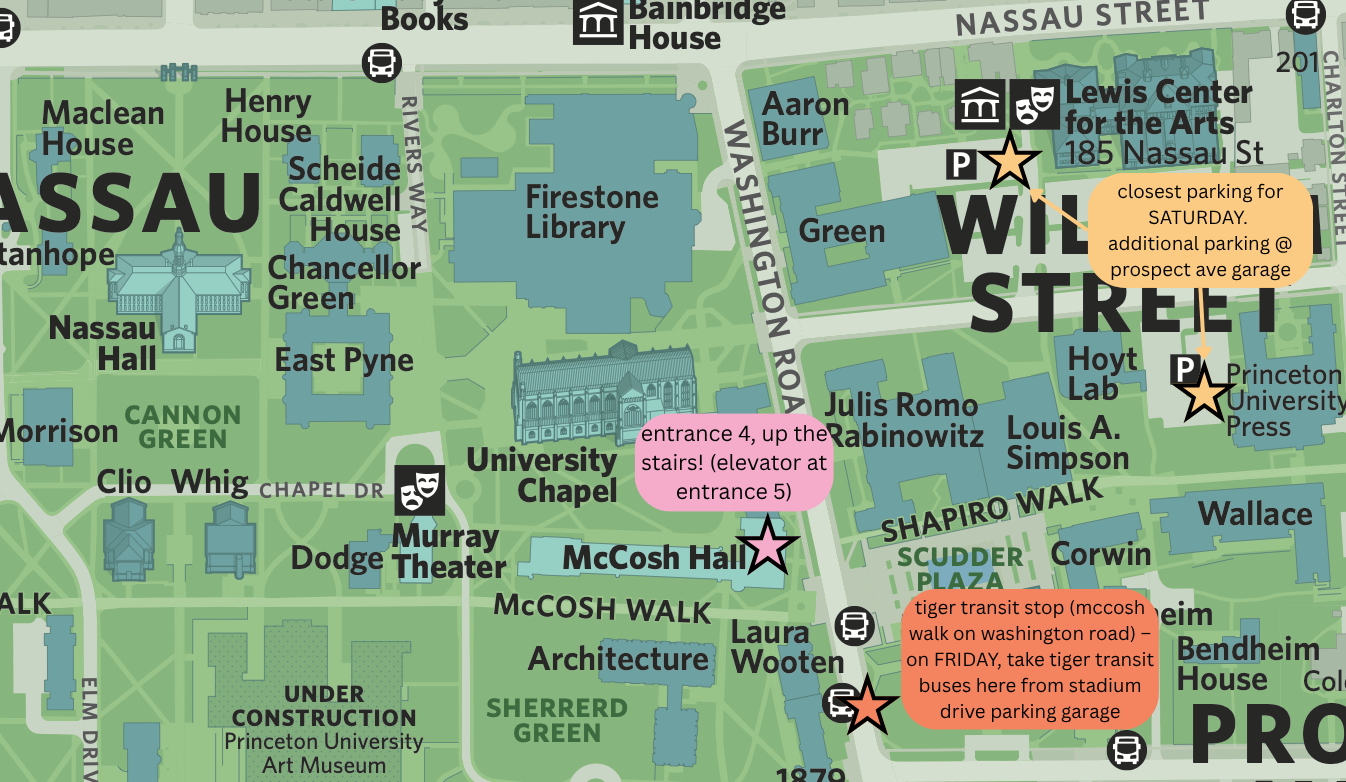
LOCATION + PARKING MAP
Logistical Information
-
Our conference will take place in McCosh Hall, room 46, next to Washington Road. Please see the above map to guide you to our location.
Enter McCosh Hall at entrance 4; room 46 is on the second floor, right up the stairs as you enter. We will hopefully have signs outside the building on the conference days.
The location of the student activist social and the reception dinner will be sent via email to registered attendees, with instructions on how to reach the sites.
-
Our campus is easily accessible via public transportation! You can take the Northeast Corridor line on NJ Transit from New York City, Newark, New Brunswick, and Trenton (with connections to Philadelphia via SEPTA). Get off at Princeton Junction and take the “Dinky” shuttle, then walk north towards McCosh Hall. You can also take NJ Transit buses 600, 605, or 606.
Visitor parking rules on campus differ on weekdays and weekends. For visitors on Friday, we recommend parking in the Stadium Drive Garage and taking the TigerTransit bus to the McCosh Walk on Washington Road stop. You must register for a visitor’s parking permit ahead of time. See the above map for details, and find more information here.
For visitors on Saturday, you are free to park in any university lot — the closest to our location are Lots 10 and 13 or the Prospect Avenue Garage. (See above map.)
-
Light snacks will be provided on Friday, as well as at the Friday evening student social.
On Saturday, we will be providing:
Breakfast, 9:30 - 10 am, McCosh 46
Lunch, 12:15 - 1:15 pm, McCosh 46
Dinner at our conference reception, 6-8 pm, location sent to registered attendees
Vegetarian options will be available at all meals. If you have dietary restrictions that you would like accommodated, please notify us in your regisration by April 1.
-
We aim to make this conference as accessible as we can. If you would like to request accommodations, please notify us in your registration and register by April 1.
*UPDATE 4/10: We arrived to the building this morning to find out that the elevator is unfortunately broken, and Facilities tells us it cannot be fixed until Monday. We are obviously deeply disappointed and greatly apologize for any inconvenience or difficulty this causes. If you have concerns about mobility/accessibility, please contact kristinnagy@princeton.edu as soon as possible to see if we can work something out. Our Student Activist Social and Reception Dinner will still be wheelchair accessible and we invite all to join us.
McCosh Hall 46, where the main events will be taking place, is wheelchair-accessible. To view the accessibility information for buildings across campus, please visit https://www.accessableusa.com/princeton-university.
-
We have some funds set aside to make our conference accessible to all, regardless of financial background; we will hopefully be able to reimburse travel costs and/or missed wages. We will prioritize community organizers, justice-impacted individuals, and others who are too often excluded from academic and policy spaces, from the New Jersey/NYC/Philly areas. If you would like to request this support, please note so in your registration by April 1.
-
Undergraduate students from universities outside of New Jersey, New York City, and Philadelphia may request lodging in a SPEAR student’s dorm in order to stay for multiple days of the conference. This support is not guaranteed; please register by April 1 to be considered.
With any questions, comments, or concerns, please reach out to SPEAR co-presidents Kristin Nagy (kristinnagy@princeton.edu) and Ila Prabhuram (ila.prabhuram@princeton.edu).